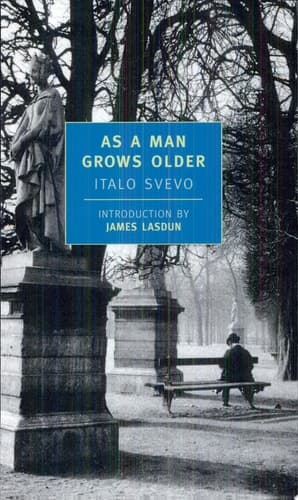
As a Man Grows Older
by Italo Svevo
About this book
Publication Details
- Publisher
- New York Review of Books
- Published
- 2001
- Pages
- 256
- ISBN
- 9780940322844
- Language
- en
About Italo Svevo
Aron Ettore Schmitz (December 19, 1861 – September 13, 1928), better known by the pseudonym Italo Svevo, was an Italian businessman and author of novels, plays, and short stories. Born in Trieste (then in Austria-Hungary) to a Jewish family, Italo Svevo (literally swabian Italian) wrote the classic novel La Coscienza di Zeno (rendered as Confessions of Zeno, or Zeno's Conscience) and self-published it in 1923. The work, showing the author's interest in the theories of Sigmund Freud, is written in the form of the memoirs of one Zeno Cosini, who writes them at the insistence of his psychoanalyst. Schmitz's psychoanalyst was Ottocaro Weiss, who had been trained by Freud in Vienna. Schmitz's novel received almost no attention from Italian readers and critics at the time. The work might have disappeared altogether if it were not for the efforts of James Joyce. Joyce had met Schmitz in 1907, when Joyce tutored him in English while working for Berlitz in Trieste. Joyce read Schmitz's earlier novel Senilità, which had also been largely ignored when published in 1898. Joyce championed Confessions of Zeno, helping to have it translated into French and then published in Paris, where critics praised it extravagantly. That led Italian critics, including Eugenio Montale, to discover it. Zeno Cosini, the book's hero, mirrored Schmitz, being a businessman fascinated by Freudian theory. Schmitz was also a model for Leopold Bloom, the protagonist of Joyce's Ulysses. Schmitz was a citizen of the Austro-Hungarian Empire until the end of the First World War. He spoke Italian as a second language (as he usually spoke the Triestine dialect, similar to Venetian) and, according to some critics, wrote it badly - though some have pointed out that it is not bad Italian, but rather the official Tuscan dialect in a Triestino mouth. Confessions of Zeno never looks outside the narrow confines of Trieste, much like Joyce's work, which rarely left Dublin in the last years of Irelan
More by Italo Svevo


Track your reading journey with BookOwl