
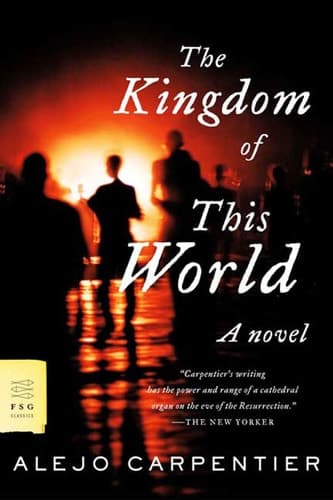
The Kingdom of This World
About this book
Publication Details
- Publisher
- Farrar, Straus and Giroux
- Published
- 1989
- Pages
- 190
- ISBN
- 9780374521974
About Unknown Author
Alejo Carpentier y Valmont (Lausana, 26 de diciembre de 1904-París, 24 de abril de 1980) fue un escritor cubano y francés que influyó notablemente en la literatura latinoamericana durante su periodo de auge. La crítica lo consideró uno de los escritores fundamentales del siglo XX en lengua española, y uno de los artífices de la renovación literaria latinoaméricana, en particular a través de un estilo que incorpora varias dimensiones y aspectos de la imaginación para recrear la realidad, elementos que contribuyeron a su formación y uso de «lo real maravilloso». Entre sus novelas destacan *El reino de este mundo* (1949), *Los pasos perdidos* (1953), *El siglo de las luces* (1962), *El recurso del método* (1974) y *La consagración de la primavera* (1978). Fuente: [Wikipedia](https://es.wikipedia.org/wiki/Alejo_Carpentier) ---------- Alejo Carpentier y Valmont (Lausanne, December 26, 1904 – Paris, April 24, 1980) was a Cuban-French writer who had a significant influence on Latin American literature during its golden age. Critics considered him one of the most important writers of the 20th century in the Spanish language, and one of the key figures in the literary renewal of Latin America, particularly through a style that incorporates various dimensions and aspects of the imagination to recreate reality—elements that contributed to his development and use of what he termed "magical realism." Among his novels are *El reino de este mundo* (1949), *Los pasos perdidos* (1953), *El siglo de las luces* (1962), *El recurso del método* (1974) y *La consagración de la primavera* (1978).
More by Unknown Author




Track your reading journey with BookOwl