About this book
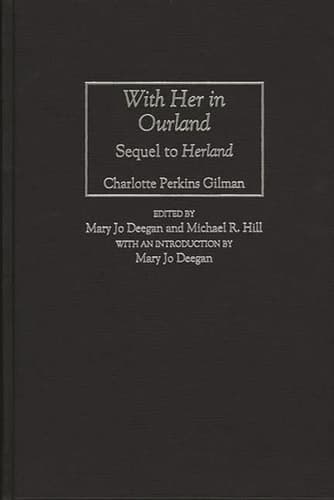
Two works in one, this volume contains the full text of With Her in Ourland by Charlotte Perkins Gilman, as well as an illuminating sociological analysis by Mary Jo Deegan with the assistance of Michael R. Hill. Ourland is the sequel to Gilman's acclaimed feminist utopian novel Herland; both were published in her journal, The Forerunner, in 1915 and 1916. Ourland resumes the adventures of ^IHerland^R's protagonists, Ellador and Van, but turns from utopian fantasy to a challenging analysis of contemporary social fissures in his land, or the real world. The republication of Herland as a separate novel in 1979 revived critical interest in Gilman's work but truncated the larger aims implicit in the ^IHerland/Ourland^R saga, leaving an erroneous understanding of Gilman's other/better half of the story, in which it is suggested that strong women can resocialize men to be nurturant and cooperative. Gilman's choice of a sexually integrated society in With Her in Ourland provides us with her answer to her ideal society, but her foray into a woman-only society as a corrective to a male dominated one is a controversial option. The challenging message of Ourland, however, does not impede the pleasure of reading it as a novel.<br/><br/>Though known more for her fiction today, Gilman in her time was a recognized and accomplished sociologist who admired Lester F. Ward and frequently visited Jane Addams of Chicago's Hull-House. The male protagonist in Herland/Ourland, Van, is a sociologist, used by Gilman as a foil on which to skewer the assumptions and practices of patriarchal sociology. The interpretation presented here, which adopts a sociological viewpoint, is invaluable reading for scholars and students of sociology, American women's studies, and utopian literature.
About Mary Jo Deegan
Charlotte Perkins Gilman, also known as Charlotte Perkins Stetson, was a prominent American sociologist, novelist, writer of short stories, poetry, and nonfiction, and a lecturer for social reform. She was a utopian feminist during a time when her accomplishments were exceptional for women, and she served as a role model for future generations of feminists because of her unorthodox concepts and lifestyle. Her best remembered work today is her semi-autobiographical short story, ***The Yellow Wallpaper***, which she wrote after a severe bout of post-partum depression.
She was the daughter of <a href="https://openlibrary.org/authors/OL352823A" target="_blank">Frederic B. Perkins</a>.
Track your reading journey with BookOwl