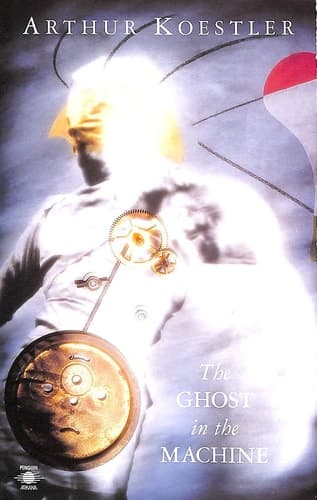
The ghost in the machine
4.7
(3 ratings)384 pages1989ArkanaISBN 9780140191929
Concept of MindCartesian mind-body dualismHuman beingsphilosophical psychologyHommeGenetic psychologyHuman evolutionSocial PsychologySocial changeÜberlebenMenschheitAnthropologieBritish and irish fiction (fictional works by one author)BehaviorPhilosophyBehaviorism (Psychology)PsychologyBehavioral GeneticsBiological Evolution
About this book
The Ghost in the Machine is a work in philosophical psychology published in 1967. The title is a phrase coined by the Oxford philosopher Gilbert Ryle to describe the Cartesian dualist account of the mind–body relationship. Koestler shares with Ryle the view that the mind of a person is not an independent non-material entity, temporarily inhabiting and governing the body. One of the book's central concepts is that as the human brain evolved, it retained and built upon earlier, more primitive brain structures. The work attempts to explain humanity's tendency towards self-destruction in terms of brain structure, philosophies, and its overarching, cyclical political–historical dynamics, reaching the height of its potential in the nuclear arms arena. Note: Although he appropriated Ryle's phrase for his title and shared some of his views, Koestler had a pretty low opinion of Ryle himself -- he dismissed him as a 'snickering' Oxford don with no knowledge of any of the sciences that would have given his ideas more weight. Ryle nevertheless had the philosopher's gift for analogy, and used a number of metaphors for the mind-body problem, all of which could have supplied titles: they included 'the sealed signal box', 'the two parallel theatres' and 'the horse in the locomotive'.
Publication Details
- Publisher
- Arkana
- Published
- 1989
- Pages
- 384
- ISBN
- 9780140191929
- Language
- en
About Unknown Author
Arthur Koestler CBE was a prolific writer of essays, novels and autobiographies. He was born into a Hungarian Jewish family in Budapest but, apart from his early school years, was educated in Austria. His early career was in journalism. In 1931 he joined the Communist Party of Germany but, disillusioned, he resigned from it in 1938 and in 1940 published a devastating anti-Communist novel, Darkness at Noon, which propelled him to instant international fame. ([Source][1]) [1]: https://en.wikipedia.org/wiki/Arthur_Koestler
More by Unknown Author



Track your reading journey with BookOwl